What we teach
For girls and women, and boys aged 6 to 12 in the children's classes, taught by sisters. Every class runs at beginner and intermediate level. Pay what you can monthly. Advanced classes are coming soon.
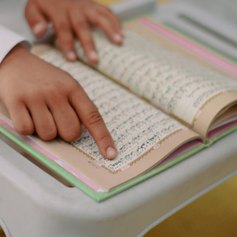
Qira'ah
القراءةal-qirā’ah
- Arabic letters and sounds.
- Qa'idah and Nur al-Bayan for complete beginners.
- Fluent, confident reading of the mushaf.
- Memorisation at your own pace.
- Correcting long-standing mistakes.
- Tamhidi and Ibtida'i for boys and girls from 6 to about 12; I'dadi for girls from 12 to 15; Fasl al-Kibar for women.
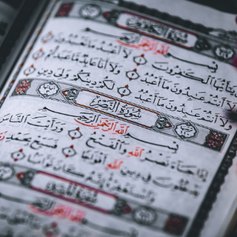
Tajweed
التجويدat-tajwīd
- Makharij, where each letter comes from.
- Sifaat, the qualities of the letters.
- Noon saakin, tanween and meem saakin.
- Madd, its kinds and its lengths.
- Stopping and starting in the right places.
- A teacher who listens and corrects you in every class.

Tafseer Class for Kids
التفسيرat-tafsīr
- Why was this verse sent down? Children remember the story long after they have forgotten the explanation.
- The short surahs first, the ones they already recite.
- What was happening, who it was about, and what changed.
- One lesson from each verse, small enough to use this week.
- Taught from recognised classical works of tafseer.
- Women are taught separately, at their own level.
Hadith
الحديثal-ḥadīth
- Forty Hadith of Imam an-Nawawi.
- Selections from Riyad as-Salihin.
- Short hadith for young children.
- How a hadith is graded, taught simply.
- Practising the hadith, not only knowing it.

Adhkar
الأذكارal-adhkār
- Morning and evening adhkar.
- Du'a for eating, sleeping and travelling.
- Adhkar after every salah.
- Correct pronunciation and meaning.
- Memorised gently, a little each week.

al-Lughah al-Arabiyyah
اللغة العربيةal-lughah al-ʻarabiyyah
- Reading and writing the script.
- Everyday vocabulary.
- Understanding Qur'anic words.
- Simple conversation.
- The foundation for Nahw and Sarf.

Nahw
النحوan-naḥw
- How a sentence is built, and why the endings change.
- I'rab, and what each ending tells you.
- The jumlah ismiyyah and the jumlah fi'liyyah.
- Examples from the Qur'an itself, not invented ones.
- Classical texts at a pace a beginner can follow.
Sarf
الصرفaṣ-ṣarf
- How one root turns into a whole family of words.
- The verb patterns, and what each one does to the meaning.
- Past, present and command verbs, built rather than memorised.
- Reading a word you have never seen and knowing what it means.
- Helps you use your Nahw in real Arabic, not only recite the rules.

Muraja'ah Circles: Juz 'Amma and Juz Tabarak
المراجعةal-murājaʻah
- For those who have memorised Juz 'Amma or Juz Tabarak, in part or in full.
- You recite your portion and a teacher corrects you.
- Then we read the meaning of each ayah together and reflect on it.
- A set schedule so that you do not forget what you memorised.
- For sisters, with a separate circle for girls.
- The group keeps you consistent.